- 5 min read
- chatbot pricing
Website Chatbot Costs: How to Compare Plans and Usage Limits
Compare website chatbot costs using the billing unit, included allowance, required features and overage rules. Two worked examples show why the cheapest plan can change as usage grows.
By Eman El-Bakry
Read this article in Arabic
A website chatbot's cost depends on the plan, what counts as billable usage and the features your team needs. Compare the total for your expected workload, including overages and staff time, rather than the advertised monthly fee alone.
Start by separating a subscription for an existing tool from a custom development quote. The second may include design, integrations, hosting and ongoing maintenance. This guide focuses on comparing subscriptions for website support.
First, identify what the provider counts
Your conversation volume is not automatically the number of units on an invoice. One conversation may contain several AI replies, and a returning visitor may start another billable session under the provider's rules.
Pricing model | What you need to establish |
|---|---|
Subscription with an allowance | Which usage is included, when it resets and what happens above the limit |
Messages or credits | Which replies or operations consume credits, and whether the AI model changes consumption |
Conversations or sessions | When a billable conversation starts, ends or counts again |
Resolutions or outcomes | The exact event that triggers a charge, including any qualifying handoffs |
Seats plus AI usage | Which team members need paid access and whether AI is an additional charge |
These distinctions exist in real products. Chatbase's documentation describes message-credit consumption that varies by model. Intercom's Fin documentation distinguishes resolutions from other billable outcomes, including certain configured procedure handoffs. Neither unit can simply be read as “one visitor”. Definitions checked on 21 October 2026; confirm the applicable terms before buying.
Ask the provider to show how your own sample conversation appears in its usage report. A short exchange and a long conversation may consume different amounts under a credit model. Keep a vendor's billable “resolution” separate from your own assessment of whether the customer's problem was solved.
Compare plans that can do the same job
An entry plan is only relevant if it includes what you need. Record these items beside each quote:
Team and deployment: required seats, agents and website domains.
Knowledge: source limits, storage, file-size restrictions and update options.
Support workflow: human inbox, handoff and access permissions you actually need.
Add-ons: branding removal, integrations, extra storage or other necessary features.
Limits: usage alerts, a spending cap, automatic top-ups, upgrade requirements or service interruption.
Ask whether the advertised rate is paid monthly or is a monthly equivalent billed annually. A fictional $20 monthly equivalent paid for a year means a $240 commitment, not twelve optional $20 payments. Check renewal, cancellation and refund terms separately.
For Egypt and Gulf businesses, keep quotes in their original currencies first. Then use the exchange rate and payment fees applicable to your payment method, and add any tax actually shown on your quote or checkout. Do not compare a tax-inclusive monthly quote with a pre-tax annual equivalent.
Calculate an ordinary month and a busy month
The following prices are fictional examples, not ZolAi prices, competitor quotes or market averages. Assume both plans include the same required features and two team seats. Both are paid monthly in US dollars, before tax and payment fees.
Plan A: $30 a month, including 500 billable conversations. Additional usage is purchased in whole packs of 500 for $20 each.
Plan B: $50 a month, including 1,500 billable conversations. The two scenarios below stay within that allowance.
Assume the providers count the same workload as the same number of billable conversations. If their definitions differ, establish each count before using this comparison.
Scenario | Plan A software bill | Plan B software bill |
|---|---|---|
Ordinary month: 400 conversations | $30; within the allowance | $50; within the allowance |
Busy month: 1,400 conversations | $30 + two $20 packs = $70 | $50; within the allowance |
The busy month exceeds Plan A's allowance by 900 conversations. Because packs contain 500 each, it needs two packs, not 1.8 packs. Plan A is cheaper in the ordinary month; Plan B is cheaper in the busy month. Neither conclusion makes one universally cheaper over a year.
For a seasonal business, price the actual mix of months and check whether upgrades, downgrades and unused allowances work as assumed. An annual commitment or a minimum purchase can change the result.
Add the work that remains with your team
Use this budget structure without counting included usage twice:
Monthly operating cost = subscription + extra billable usage + required add-ons + staff time valued at your chosen internal rate.
Keep one-off setup costs separate, or state the period over which you spread them. Staff time includes source updates, answer checks and human follow-up. The worked table above contains software charges only; it does not establish savings or a complete support budget.
To compare cost per conversation, divide the costs included in your calculation by conversations counted over the same period. If you measure cost per resolution, use genuinely resolved cases under a consistent definition. An automated reply or a handoff is not proof of resolution.
Use the trial to collect billing evidence
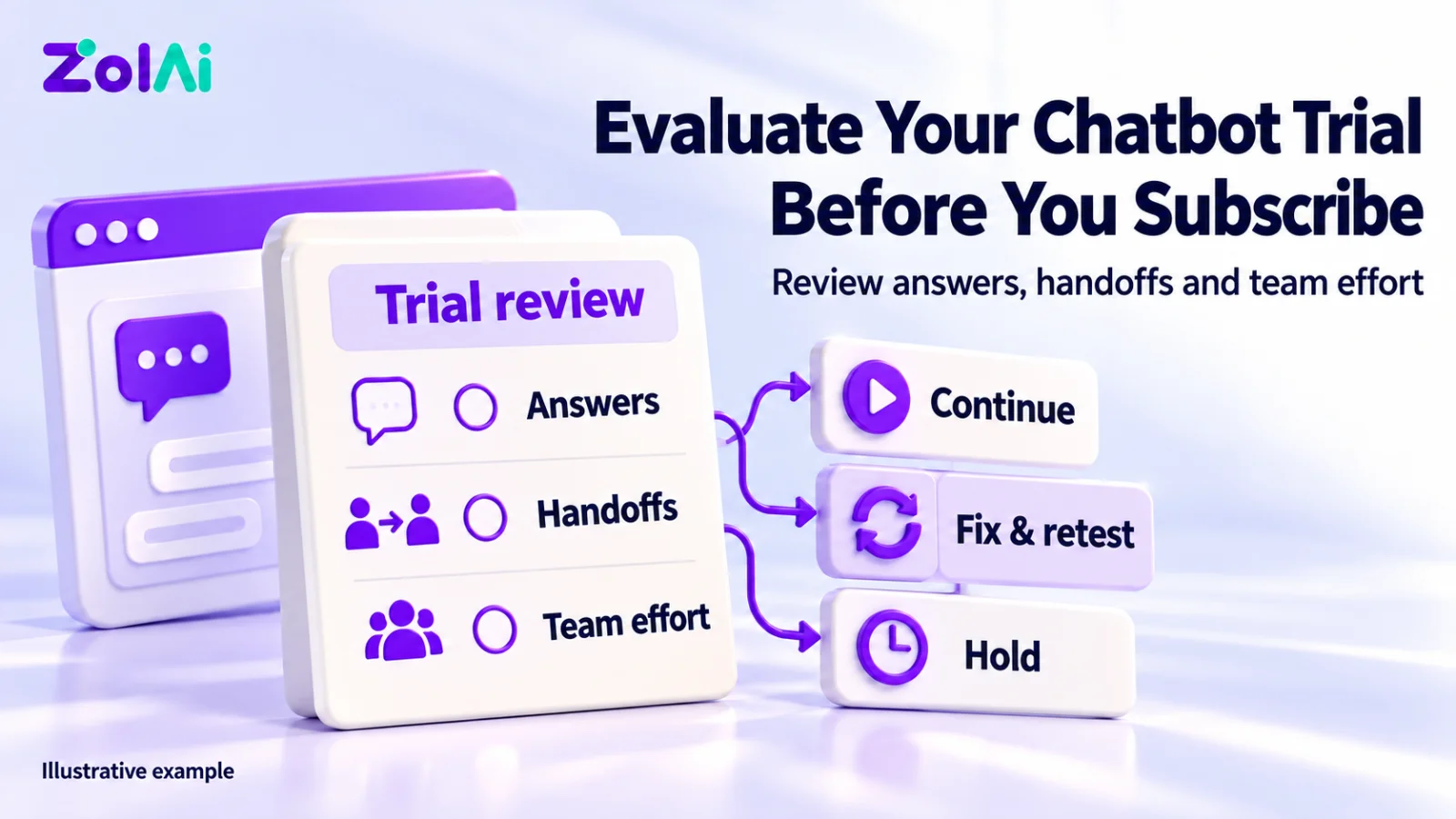
A free trial is temporary access; a permanent free plan is a different offer with its own limits. Before paying, use representative questions to check answer quality, human follow-up and the usage recorded. Include long exchanges and questions the assistant cannot answer. Ask whether testing consumes your allowance and whether paid billing starts automatically.
If you still need to choose how people and automation share support, compare live chat and AI chatbots. Once the operating requirements and budget are clear, use the website chatbot selection guide to shortlist suitable tools.
For ZolAi, check the current plans and allowances rather than applying the fictional prices above. Start a trial with your own content and questions; the current offer is 14 days without a credit card. Record what the trial demonstrates, then confirm the paid plan's billing unit, limits and required features before subscribing.