- 4 min read
- rule-based chatbot
Rule-Based vs AI Chatbots: Which Fits Your Customer Questions?
Choose between predefined chatbot paths and AI-generated answers by testing your own questions, exceptions and maintenance needs. Includes a practical comparison and trial exercise.
By Eman El-Bakry
Read this article in Arabic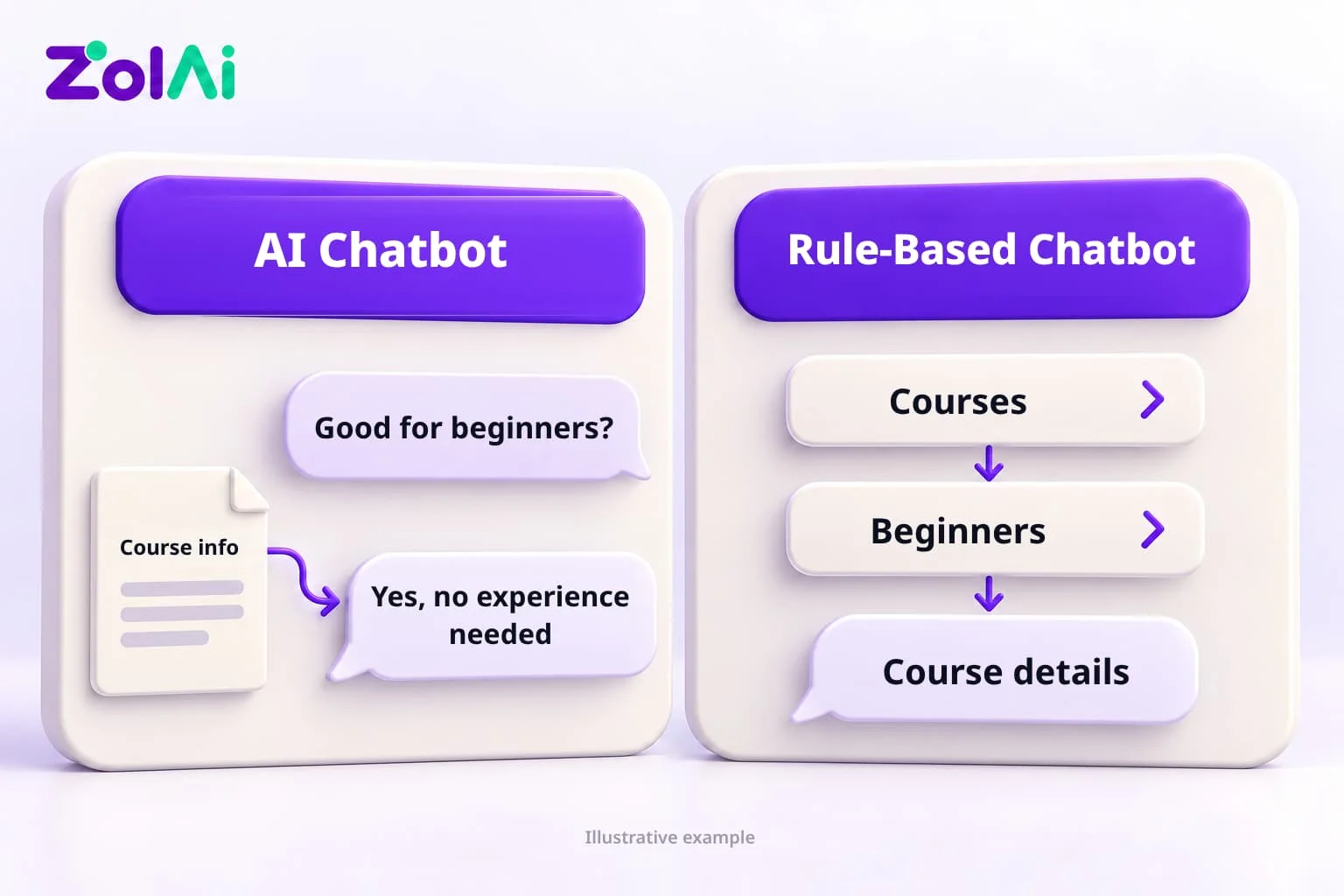
Choose a rule-based chatbot when customers can follow a small set of clear paths with approved responses. Trial an AI chatbot when visitors express varied questions that need answers from maintained business information. A combination can use AI for wording and rules for tightly controlled steps.
The deciding factor is how the system handles your actual requests, including those it cannot complete. Buttons alone do not tell you what runs behind the conversation.
Compare the work each approach needs
A rule-based chatbot chooses a response or next step from predefined conditions. An AI chatbot can interpret or generate language using models. For support, a generative system may retrieve business information and write an answer from it.
IBM's chatbot overview distinguishes menus, rule-based paths and AI-powered systems. Real products can combine these mechanisms, so evaluate the behaviour you need rather than relying on a product label.
Decision factor | Predefined paths | AI-generated answers |
|---|---|---|
Customer input | Works well with anticipated choices and wording | Can handle varied wording; test your languages and topics |
Response control | You write the branch and its answer | You maintain sources, instructions and evaluation |
New or combined requests | Needs an appropriate branch, clarification or exit | May interpret them, but can miss details or invent information |
Maintenance | Update affected rules, answers and branches | Update sources and review the resulting answers |
Exceptions | Route to a defined next step | Detect the limit and use a verified next step |
Neither column guarantees correctness. A scripted answer can repeat an old price perfectly; an AI answer can misread a current condition.
When a short rule-based flow is enough
Consider a site where most visitors need a branch address, opening hours or a route to the right department. A few labelled choices may get them there without a free-form exchange.
Keep the paths short. A visitor should be able to go back, correct a choice and reach help when none of the options fits. Adding another branch to every failure can create a menu nobody wants to navigate.
Rules can also control actions connected to other systems. A rule-based design does not inherently prevent integrations, just as an AI design does not automatically provide them. Checking an order still requires appropriate data access and permissions.
When varied questions justify testing AI
AI is worth evaluating when the same customer intent appears in many forms, or a question combines details from your published information. Think of a visitor asking whether a course suits a beginner who cannot attend live.
That needs more than recognizing the word “course.” The reply must preserve the prerequisites, recording availability and any conditions in the source. If your information does not cover the visitor's situation, the assistant should clarify or refer it to the team.
Do not assume it learns a new policy automatically from a conversation. Check the actual source-update process and who approves new information. Treat language fluency and business accuracy as separate tests.
Try both approaches on one small enquiry set
Use the following hypothetical exercise, substituting your own policy:
Ask the standard question: “How long can I access the recordings?”
Ask an equivalent version in the wording customers use.
Combine it with a prerequisite question.
Ask for an exception absent from the policy.
Correct an earlier choice and then request a person.
For a rule-based candidate, check the number of steps, dead ends and work needed to support those cases. For AI, check every answer against the approved source and record unsupported additions. For both, check whether a person receives the unresolved request.
Choose the simplest approach that completes the important cases and can be maintained by your team. Keep critical action permissions explicit, even if AI interprets the initial request.
If you need to decide whether people or automation should answer, use the separate live chat vs AI guide. To compare products after choosing an approach, see the website chatbot selection criteria.
ZolAi is a candidate for website questions answered from business content in Arabic and English, with human follow-up when needed. Try it on your own enquiry set rather than judging from a demonstration alone.