- 4 min read
- chatbot platform
Prebuilt vs Custom Chatbot: Which Should Your Business Choose?
Decide whether to use a chatbot platform, commission a custom system or combine both. Compare essential requirements, operating ownership and exit terms before committing.
By Eman El-Bakry
Read this article in Arabic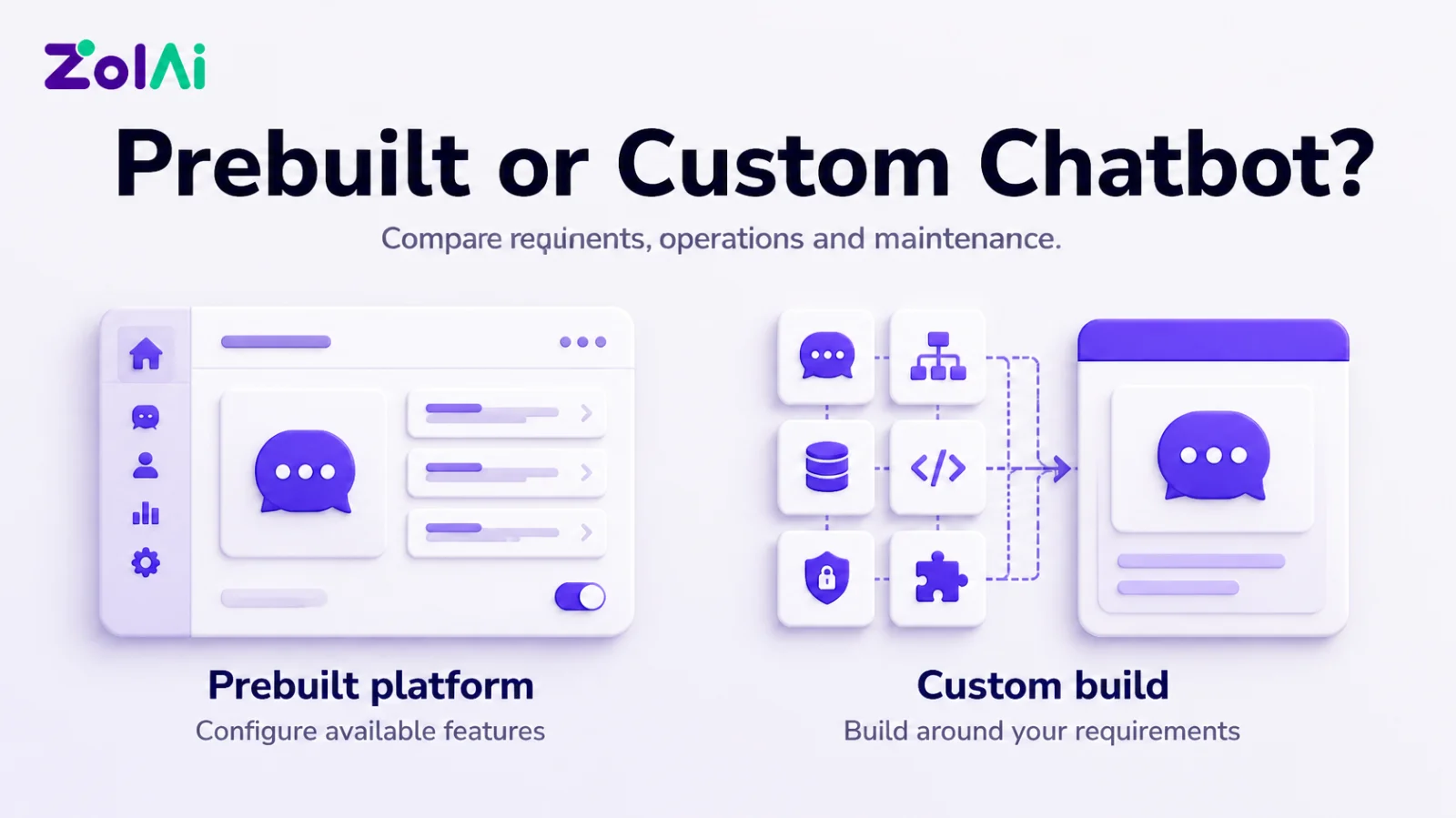
Choose a prebuilt chatbot platform when it can demonstrate your essential tasks and your team can operate it within acceptable limits. Consider custom development when a requirement the business truly needs cannot be met by suitable platforms, and you can fund and own ongoing maintenance. A platform with a custom integration can be a third option.
Buying and building describe how you obtain and operate the application. Either approach can use AI, predefined rules or both.
Write the requirements before comparing proposals
Describe outcomes a supplier can demonstrate. “Support Arabic” is too broad; “answer these Egyptian and Saudi customer questions correctly from our approved policy” is testable.
Start with this proposed comparison worksheet:
Requirement | Proof to request | If it fails |
|---|---|---|
Answer from approved Arabic and English content | The same questions and expected answers in both languages | Revise the scope or reject the candidate for that task |
Hand unresolved requests to staff | A complete test from visitor request to staff receipt | Do not depend on the handoff yet |
Read a specific private record | Permission checks and a test against the correct account | Keep the request with authorised staff |
Meet your data-handling requirements | Written terms and relevant technical evidence | Resolve before processing that data |
Let you leave the service or developer | An export, access and removal demonstration | Negotiate a workable exit before commitment |
Separate essential requirements from preferences. A colour setting should not outweigh a failed access-control requirement.
What a platform gives you, and what you still own
A platform provides capabilities you configure rather than assemble entirely yourself. You still need to check its supported sources, usage limits, staff workflow and required integrations.
Do not count a connector's name as proof that it handles your task. An API integration may read information, write changes or do neither without additional work. Ask which operations are supported and who maintains failures or API changes.
Your team still owns accurate business content, reviewing answers and responding to customers. A subscription does not automatically include writing your policies or operating your support desk. Compare the relevant billing terms separately with the website chatbot cost guide.
What a custom build puts under your control
A custom project can target a particular interface, process or system connection. It can use existing model APIs and managed services; “custom” does not mean training a language model from scratch.
Control brings responsibilities. Name who will maintain source ingestion, model access, hosting, permissions, logs, tests and human follow-up. If an agency builds it, identify who responds when it stops working and what support the agreement covers.
CM.com's build-or-buy discussion includes ongoing development and operations in the comparison. Use that as a reminder to compare the running service, not only the first working demo.
Custom development does not establish that you own every component or that data stays in your infrastructure. Check the code rights, accounts, dependencies, model providers, retention arrangements and deletion process in the actual agreement.
Compare the same scope over the same period
Ask both suppliers to respond to one short brief:
The customer task, channels and languages required now.
Approved sources and how changes reach the system.
Any private-data access or actions, including permissions and failure handling.
Acceptance cases, human follow-up and unresolved-request ownership.
Setup work, recurring charges, usage assumptions and maintenance responsibilities.
Access, export and removal steps when the relationship ends.
Choose a common comparison period that suits your planning. Include staff time, integrations and maintenance alongside subscription or development charges. Do not use an assumed market price or a prototype estimate as a guaranteed operating cost.
If one supplier quotes answering public FAQs and the other quotes authenticated order changes, the proposals are not comparable yet. Narrow or align the requirements first.
Use a small trial to settle the decision
Consider a hypothetical service business that needs published service answers and enquiries passed to its team. A platform may cover that scope. If it later needs authorised changes inside a proprietary system, that new requirement needs its own proof and implementation decision.
Test a platform before commissioning work solely to reproduce features already available. Conversely, do not bend an essential process around a product that cannot demonstrate it. Use the chatbot selection criteria to assess candidates consistently.
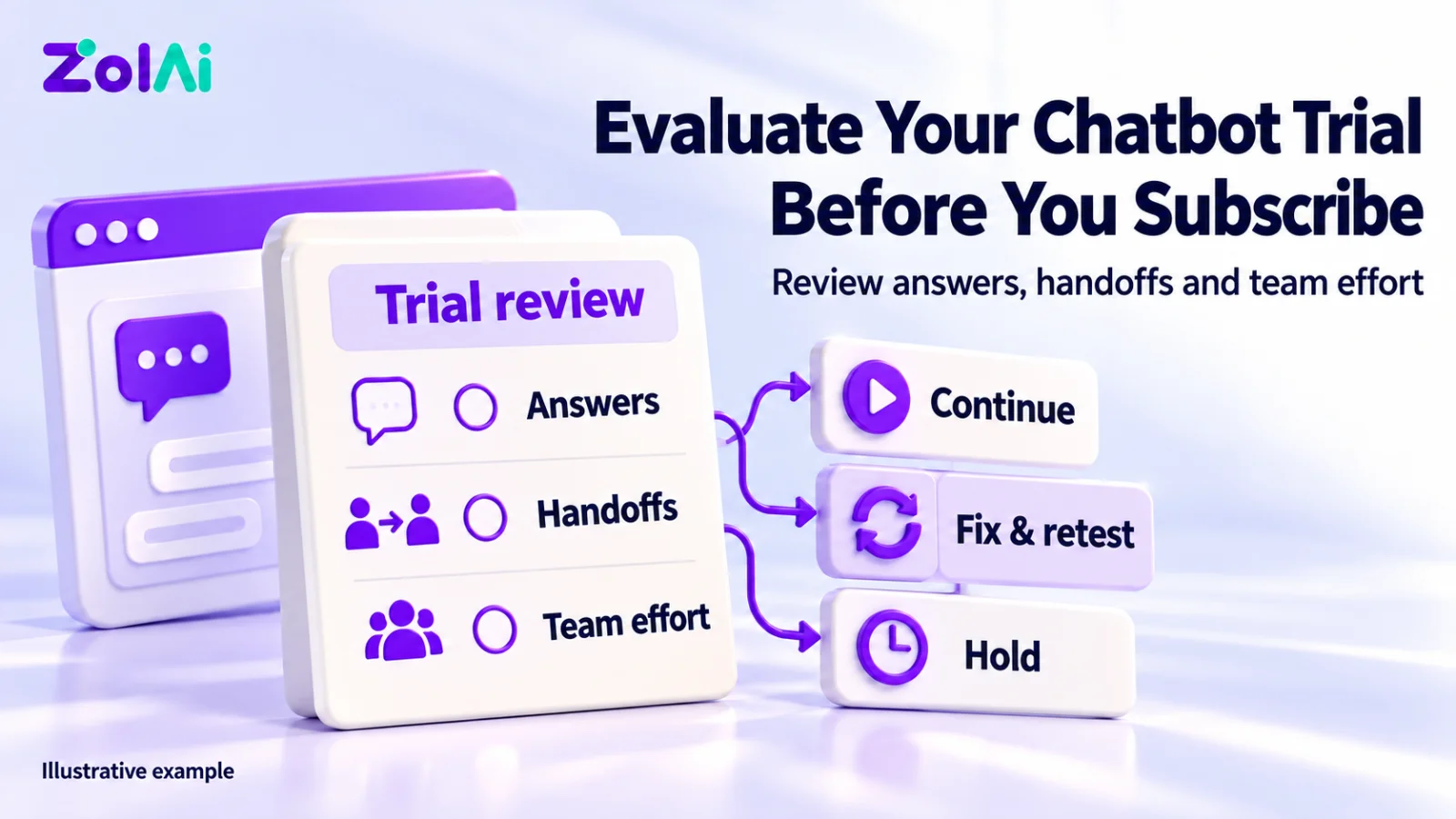
For website answers from business content with a team inbox and human handoff, evaluate ZolAi in a trial. Bring the same essential requirements and acceptance cases you would use for a custom proposal.